| Barbecuen On The Internet's The Smoke 'N Fire Enquirer |
 December 1, 2004 |
Issue: 12.a |

Smoke 'N Fire Enquirer Is Sponsored by:
The Barbecue Store



Shop today for your Free Basting Mop
(an $8.49 Value)
Hi {FirstName},
In each issue of the Smoke 'N Fire Enquirer we offer you unique tidbits on all aspects of outdoor cooking. You would have to search high 'n low to collect the unique information we offer - - - all for FREE! Keep on smoking!
By supporting The Barbecue Store in your purchases we can offer you more great techniques to cook by.




BARBECUE
STORE

 Hi {FirstName},
We hope you enjoyed the Thanksgiving holiday and had some "down time" with friends and family. We are now in the home stretch for the final holidays and year-end celebrations. Time for that shopping and party planning. If you are entertaining this holiday season, don't forget grilled wings, smoked salmon and grilled veggies are quick 'n easy to fix and serve. In this issue, we'll will be discussing ...
Want to hear a particular topic? Let us know! Did you miss our last issue? Read it here! Keep On Barbecue'n, P.S. Winter cooking is Cool!

Smoky's Suggestions For Better
Cooler Weather Cooking
Also in issue we have for you ...
 Grilled Garlic Butter-Basted Pork Loin Recipe
Great New Store Items & Store Sale
Old Smokey Contest Winner
Free Basting Mop Offer
Recent Equipment Recalls

Charlie McMurrey
Smoky's Suggestions For Better
Cooler Weather Cooking
It happens every year, just about this time. The first cold snap in South Mississippi means that Fall is actually going to cool things off. While most of the US has already had some cold nights, our Canadian friends are feeling wintry weather. Not surprisingly, Canadians seem less inclined to let inclement weather effect their outdoor cooking schedule. With a little planning and creativity we can all extend our outdoor cooking season to year round. We are mostly concerned with the effect on the cooker, rather than on the cook. We can dress for the occasion; the cooker needs our help.
So let’s look at the factors that rob our pits of BTUs, analyze the effect they have and figure our way around them. The big three, in increasing effectiveness, are: temperature, wind and moisture. And their effect is progressively more severe from broiling, to roasting, to barbecuing to hot smoking. So that we all agree on what those terms mean, it is my belief that at least 95% of those who call what they are doing in a pit at 225-350 degrees “smokin’”are really roasting in a smoky atmosphere at the top of that range and approximating barbecue at the bottom of that range. True hot smoking is done below 190 degrees and cold smoking is done below 90. Barbecuing is done between 190 degree and 225 degrees, roasting is done between 225 and 450 and broiling is done above 500 degrees. It stands to reason that the longer the cooking takes the greater the effect of foul weather.
Unless it is pouring rain into the grill, successful broiling just requires that you boost up the fuel pile to supply the extra BTUs needed to reach the desired temperature for the 10 minutes or so needed to broil a steak. Long term cooking is another matter entirely.
The ambient (outside) temperature has only a small impact on the grill, but when accompanied by wind and water, the effects on cooking temperatures and time can be dramatic. Even when the summer heat is upon us, water sucks up BTUs like a biscuit does gravy. While barbecuing pork ribs near Seattle, the weather began to become a little misty and breezy. I was monitoring the temperature in the cooking chamber with a digital thermometer with its remote probe resting on one of the slabs. Although, the grill and I were under cover and the temperature was mild, I watched the temperature inside the cooking chamber take a 20 degree drop in a matter of seconds. Had I not been watching at that moment, I would have been unaware of the sudden loss of temperature.
So, shelter from moisture is essential for maintaining anywhere near normal cooking temperatures and times when roasting, barbecuing or “smokin’.” To start without shelter with threatening weather is rash, to start during any inclement weather is folly. There are a variety of temporary shelters that can be had reasonably, but if you enjoy cooking out and don’t want the weather to control you, a cooking shed, patio, covered deck can change your life.
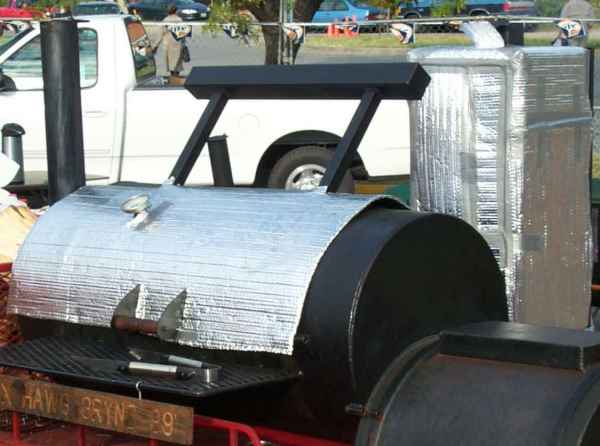 |
Next to moisture, wind is the most offensive. Often you can move your portable cooker to a more protected area. If not you can put up a temporary wind break. But, as above, you can construct a more permanent shelter. You may also wrap the cooking chamber in foil covered glass fiber insulation as a temporary, but effective solution.
 Wireless Thermometer |
 Dual Sensor BBQ Thermometer |
 Perfect Temp 2 Thermometer |
When I am doing long term cooking, I will often have one thermometer probe inside the meat and one on the meat. This lets me track the progress of the internal temperature as I monitor the cooking chamber temperature. It’s not necessary that you stay there and watch, but it is necessary that you stay aware and confirm that the temperature is rising. You do not want the meat temperature to linger too long in the “danger zone” between 40 and 140 degrees.
Now, let me give you some good advice that you should remember, even if you forget everything else. After you have had the meat in the grill for at least a couple of hours and the temperature isn’t rising as it should, fire up the oven, inside the house, and finish cooking indoors. Just put a drip pan below the meat and put the meat on the oven rack. After 2 hours on the grill, the meat has all the smoke flavor that it needs and you can set the temperature in the oven and let it finish the job. Just make sure that you bring the internal temperature up to 160 degrees for poultry. Naturally you would remove the lamb at no more than 145 and beef roast or pork loin according to your taste. But if you are barbecuing, take the pork butt up to at least 185 and the brisket likewise. The important message is "Don't make conditions more miserable than they have to be."
Have fun,
Smoky
GURU @ Barbecue'n On The Internet
Author and Lecturer
Author of Great American Barbecue & Grilling Manual
 |
We're open 24/7 for your on-line shopping experience |
|
Grilled Garlic Butter-Basted Pork Loin - Paul Kirk's Championship Barbecue |
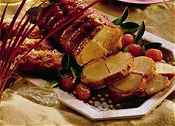
- 1 cup (2 sticks) unsalted butter
- 1/4 cup clover honey
- 6 cloves garlic, pressed
- 1/4 cup grated onion
- 1 cup flat beer
- 1 Tbs minced fresh parsley leaves
- 1 tsp coarsely ground black pepper
- One 3-5 pound boneless pork loin, trimmed of excess fat (but not all of it)
Melt butter in medium nonreactive saucepan over medium heat, add the honey, garlic and onion. Cook until the onion is soft. Add the beer and bring to a boil stirring. Remove from heat and add the parsley and pepper.
Place pork in a zippered-top gallon size plastic bag along with the sauce and seal. Shake to cover the loin and marinate at least 2 hours in refrigerator.
Prepare a medium-hot fire. Remove pork from the bag and pat dry. Transfer balance of the marinade to sauce pan and bring to a boil over high heat. Let simmer for 5 minutes and then allow to cool. Place pork loin directly over the coals, fat side up. Turn after 15-20 minutes and baste every time you turn the loin. Cook until a thermometer inserted into the center registers 145°. Cook until 155° to 165° if you like yours done more. Let rest for 10 minutes before slicing.
From Paul Kirk's Championship Barbecue
Product RecallsEven good things can go bad once in a while. So, we keep a close ear out for any product recalls that might affect our readers. We have a couple of them for you this month.
RELEASE DATE: October 21, 2004
PRODUCT: Nexgrill Industries Replace Gas Pressure Regulator (On/Off Gauge) Beefmaster Explorer Outdoor Gas Grill Model Number 720-0001
HAZARD: Gas leak and fire hazard
View this recall on-line at
http://www.cpsc.gov/cpscpub/prerel/prhtml05/05023.html
RELEASE DATE: November 10, 2004
PRODUCT: Five-burner Vermont Castings barbeque grills
HAZARD: Gas leak and fire hazard
http://www.cpsc.gov/cpscpub/prerel/prhtml05/05044.html
Holiday Time!Some of our most popular links for the holidays!
The holidays are such a wonderful time of the year to celebrate with family and friends getting together for joyful events around fun, food and fire. Barbecue can pull all of these together. Make your events a real holiday treat with all the flavors of the season. The following are some topics that should be of interest to you this week:
WISHING YOU A FANTASTIC HOLIDAY SEASON THIS YEAR
Barbecue'n On The Internet
The Barbecue Store
Old Smokey Contest Winner Each month we give away one heck of a grill to one of our lucky readers. By far, the Old Smokey Grill is our largest selling portable charcoal grill because of its durability and ability to produce great tasting food. There is only one winner each month! The winner of this month's Old Smokey Grill - #18 is:Newsletter Advertising
You can place your own 2-line ad in The Smoke 'N Fire Enquirer for the low, low price of $59.95. We send our newsletter to approximately 35,000 readers each issue.
Circulation this issue: 34520

Charlie McMurrey, The Smoke 'N Fire Enquirer
14601 Bellaire Blvd., Suite 260, Houston, TX, USA
Copyright © 2004, Nottingham Resources, Inc. All rights reserved.