image
image


Get Started @ The Barbecue Store

Check Our Weekly Recipes

Soon it will be open season on grilling!

On March 20th, Spring arrives with hope and promise of some really great barbecue!

Temperatures

Hey buddy, what temperature is it anyway?.......
What temperature is it anyway?


Thermometers, Thermostats, Thermo scopes ...

First let's define a thermometer:

WEBSTER'S DICTIONARY: Thermometer: An instrument for determining temperature consisting typically of a glass bulb attached to a fine tube of glass with a numbered scale and containing a liquid (as mercury or colored alcohol) that is sealed in and rises and falls with changes of temperature.

ANOTHER: Thermometer: An instrument that measures the temperature of a system in a quantitative way. How hot is the oven? How cold is it outside?

DIFFERENT DEVICE: Thermostat: A thermometer that uses its temperature measurements *to control* other equipment. Set the oven to maintain 350 degrees. I want the air conditioner to keep the house at 72 degrees. This is NOT the topic of discussion - simply offered for clarification.

Some of the earliest devices used to measure temperature (thermometers) were called thermo scopes. They were simple devices consisting of a glass bulb with a long tube extending downward into a container of colored water that was open to the atmosphere. Galileo, in 1610, is rumored to have used wine - good choice! As the air in the bulb was heated or cooled, the level of the liquid in the tube would rise or fall reflecting the change in the air temperature. By marking the side of the tube, a quantitative guide to temperatures was achieved.

Next came the "spirit" thermometers. In 1641, the first use of a sealed alcohol-in-glass device, with (temperature) marks on its stem was the beginning for our modern thermometer. This method was developed for Ferdinand II, Grand Duke of Tuscany.

Were you aware that Anders Celsius (1701-1744) - you know ... Celsius - actually used the reverse scale (as we know it today) where 100 represented the freezing point and zero the boiling point of water?

A year after his death, in 1745, Carolus Linnaeus of Upsula, Sweden, turned things on their heads. He designed a scale in which the freezing point of water was zero, and the boiling point 100.

For the mathematicians:
To convert from Celsius to Fahrenheit:
multiply by 1.8 and add 32. ° F = 1.8° C + 32
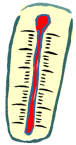
ThermometerThe early bulb thermometers relied upon the principal that liquids change volume relative to temperature. These liquids, water, alcohol, mercury rise and fall when subjected to heat and cold.

In order to gain a better handle on temperatures, along came the bimetallic strip thermometer. The use of metal rather than liquids has proven to be a much better gauge of measuring actual temperatures.

The bimetal thermometer uses the relationship of different types of metals expanding at different rates as they warm and cool. These metals are most often copper and iron. (Copper has the greater expansion coefficient and thus will expand more when heated and contract more when cooled.) These two different metals are bonded together in sandwich like fashion and can withstand fairly high temperatures. Consequently, these are often found in ovens.

TIME TO BEGIN COOKING

Which brings us now to our trusty barbecue pit. Each pit should be equipped with a reliable, sturdy and accurate bimetal thermometer, (also referred to as a chamber thermometer). This device measures the internal temperature within the cooking chamber - preferably at the vertical location where you place the meat.

Example of a Bimetal Thermometer:

Chamber ThermometersWhen cooking, say at 210 to 225 degrees (the preferred temperature range for barbecuing) you are planning for a much longer cooking period than if you are cooking at say 350 degrees (which is roasting). Meat cooking at 210 degrees obviously cooks the meat much slower than the higher temperatures. At these lower temperatures the result are meats that are more tender than if cooked at higher temperatures. If you are using an *inaccurate* thermometer, you may be cooking for long periods of time at temperatures in excess of 260-270 degrees or possibly even less than 200 degrees.

FACTORY INSTALLED THERMOMETERS

We would be remiss in not commenting on many of the factory installed thermometers offered on barbecue pits. First of all, if you have a thermometer on your pit that says WARM, MEDIUM, HOT, then you are literally "shooting in the dark" on the actual temperature. They are simply inaccurate at best. You have as good (if not better) chance of determining the temperature by placing your hand on the side of the pit as looking at that type of gauge.

Second, one person's pit may read medium which may be another person's HOT or even WARM.

Third, manufacturers using this type of thermometer are offering the least expensive measuring device (not a thermometer!) to make their pits more affordable.

If you want to control heat, you have to know the temperature at which you are cooking. It is impossible to even begin to estimate the time it will take to cook the meat without a thermometer. You should GO AND GET A REAL BIMETAL THERMOMETER!

OK, let's now look at the ideal placement of the bimetal thermometer on your pit. We all know that heat rises. Cooler air sinks. This is true in your home and in your barbecue pit. Using a typical pit which is approximately 2 feet in diameter (or, if it is rectangle, 2 feet from top to bottom) it is not uncommon to have anywhere from 40 to 70 degrees difference from the surface of the cooking grate to the top of the cooking chamber. Many manufacturers place their thermometers in the lid or on top of the cooking chamber.

Examples of incorrect locations of chamber thermometers
Iincorrect Location #1  Incorrect Location 2

Nope, that's not the correct place to measure the cooking temperature. Place your thermometer at or very near the location where the meat is being cooked. If placed too high, you will be measuring a much higher temperature and actually be cooking the meat up to 50 degrees cooler!

Examples of correct locations of a chamber thermometer
Excellent Location 1  Excellent Location 2

TESTING YOUR THERMOMETER

If you already have a bimetal chamber thermometer (or you have just bought a new one), we recommend testing it once a year. These guys are exposed to extreme temperatures and weather and sometimes will corrode or become inaccurate. An inaccurate thermometer is worthless. [EXAMPLE: I borrowed my brother's trailer rig for a large party and he had two thermometers - ONE was simply broken and if you tapped it, the needle would swing this way and that. The OTHER was reading 60 degree high!]

To test your thermometer, simply remove the thermometer from the barbecue pit and carefully place the stem of the thermometer into boiling water. It should read at, or very near, 212 degrees. Assuming this is working properly, next place the stem in a glass of water with ice cubes. Use the stem to stir the water and ice. It should read 33 or 34 degrees. Using a glass of alcohol and ice will make it closer to 32 degrees.

Your ONLY bet in controlling the cooking process on the outdoor barbecue pit is to know your temperatures!

Meat Thermometers

Last month, we discussed the differences between thermometers, thermostats, thermo scopes. We reviewed the proper way to mount and use a good quality thermometer. We then ventured into some of the more common-proper temperature ranges for cooking. Finally, we discussed the limitations of factory installed thermometers and the reasons for testing and using a quality thermometer to achieve desired results.

PROBLEMS:

Ok, now we are all on the same page once again. Let's start with my experience this father's day weekend. I was invited to a friend's event out in the country. The host had been cooking all day and we tasted venison, wild hog, sausage and chicken. The hog and venison proved to be tough (still very tasty, however). They were overcooked in only about 6 hours, sausage dried out in about 3 hours while the chicken did not get done and had to be placed in the oven. Not an uncommon event experienced around the world on any given weekend!

What's wrong with this picture? Temperatures and Time!!! First, let's take a look at what probably happened.

Let's begin with the hog. He was not all that big. You will not have anything tender, tasty and moist if over 5 pounds and under 8 hours. Wild game is usually very lean meat and as such does not have the fat associated with the domestic hog. Cooking time for this animal should have been around 10 to 15 hours at temperatures not to exceed 210 to 220 degrees. Frequent basting and careful use of heat to make the meat tender. I suspect that in the need to "GET IT DONE", temperatures exceeded 250 to 275 degrees or more. You just can't get a hog done in 6 hours otherwise. The sausage needed no more than 1 hour in 210 degree heat to cook and still be moist. Finally, the chicken was still being defrosted in the microwave about 2 hours before being placed on the table. Needless to say, when we sat down to eat, the chicken did not make the cut!

Suspected Mistakes: There was not a meat thermometer within 10 miles. The temperature was not monitored. The meat was not basted. Timing for putting the meat on the pit vs. when it needed to be done was off schedule.

For example, as we said, the hog should have been placed on the pit at 220 degrees for some 10 to 15 hours with regular basting every 30 minutes. Sausage, no more than an hour. For the chicken, it should have been defrosted much earlier, cleaned and trimmed of excess fat, seasoned, covered and in the refrigerator some 2 hours BEFORE being placed on the pit. Again, know your times, monitor your temperatures and make it tender, moist and done.

OK, how do we make the meat done (not overdone) and on time?

All of these foods need to be cooked in indirect heat. For more information on this method of cooking, please take a moment and read Smoky's article on "HEAT" @ http://barbecuen.com/heat.htm

This will give you a great foundation for learning about this cooking process.

For more on proper temperatures, please visit: Proper Temperatures

MEAT THERMOMETERS DISCUSSED:

There are several methods in determining when the meat is finished. Charlie & Ruthie Knote in their Barbecuing and Sausage Making Secrets [Knote] has a method of gauging the "doneness" through a Hand/Finger test. Squeeze the soft muscle of your hand located between the thumb and first finger. With the hand relaxed the muscle is soft. As you straighten the thumb and fingers straight and test again. It is more taught. Now try the same thing with the hand made into a fist. It becomes very firm. Now feel your knuckle. Really hard. So, your resulting doneness is as follows:

  • Hand relaxed = raw to rare
  • Thumb/fingers out straight = medium
  • Tight fist = Well done.
  • Knuckle = Definitely over done.
Most cooks, however prefer the use of really knowing the exact temperature of the meat during the cooking process. Some cooks start with a slow heat and build up in the hopes of adding more smoke flavor while others begin with more heat to sear the meat and then cool the heat down for the longer term cooking process. Both methods have merit and you will have to experiment to see which one fits your style.

The key to knowing what is going on is to, know your temperature!

We suggest several types of meat thermometers to aid in developing top quality meats from the barbecue pit. First, let's talk about the Bi-metal instant read thermometer. You know what we are talking about. . . remember going to a fancy restaurant and seeing that "button thermometer" on a long stem in the pocket of the chef? It is not for show, but to USE & KNOW when the meat is done to the proper temperature for both great taste AND making sure the meat is in the safe range to serve.

Instant Read ThermometerThe Instant Read Thermometer is a "temporary use" thermometer. That means you use it periodically by opening the pit door, placing the stem in the meat and reading the temperature. You then remove it and close the door for more cooking. This process is repeated until the meat reaches the proper temperature. This should be a standard tool!

Perfect Temp ThermometerIn the past few years, there have been improvements in the outdoor cooking technology with regard to thermometers. One of the new methods of determining the temperature is through the use of the Perfect Temperature Thermometer. These are constant reading thermometers that offer the chef the exact temperature of the meat during the entire cooking process. A heat resistant probe is inserted into the deepest portion of the meat (but away from the bone) and sends a signal to the base unit (outside the pit) via a shielded cable where the temperature is displayed.

One of the best features is that you know how the meal is coming along. NOTE: If it becomes obvious that you will not be reaching the correct internal temperature of the meat by the time the meal is scheduled, you can begin to slowly "crank up the heat". If the meat is cooking too fast, then "slow the sucker down". Imagine it as a peak inside the pit to see what is happening while keeping the door closed.

Other benefits include:

  • Faster cooking times - Less opening the lid and letting the heat out.
  • Greater control over cooking processes - Lets you experiment with cooking times and temperatures to achieve better results.
  • Select the exact temperature - 160 deg. 175 deg. 190 deg. Set *any* temperature desired.
  • Have more fun - There is an alarm on most models to alert you when the desired temperature has been achieved. Go relax!
  • No more over/under cooking! - BOTTOM LINE!
Wireless ThermometerThen for the lazy cook, high tech has taken off. They now offer a REMOTE thermometer (The Temperature Detective). Similar to the Perfect Temp thermometer in that it has a remote probe for meat BUT you can take the base unit up to 100 feet away for remote viewing of the temperature. This is a wonderful feature for you guys/gals who like to watch the ball game inside and still know what is happening on the pit.

The world of thermometers is a wonderful place to be knowing that you are cooking at the proper temperatures, the meat is cooking just fine and there will not be any more overdone/underdone meals. The savings you will reap will far exceed the price of the thermometers AND it keeps you significant other and guests smiling all the way to the desert - - - if they still have any room!

For more information on cooking temperatures, we suggest visiting:
Proper Temperatures

Enjoy knowing your temps!


Convenient Links to The Barbecue Store


Link to Trend Chamber Thermometers:
Trend Chamber Thermometers
Link to Bi-Metal Thermometer:
Bi-Metal Instant Read Thermometers
Link to Perfect Temp Thermometer:
Perfect Temperature Thermometers
Link to NU-701 Simple Wireless:
NU-701 Simple Wireless

See The Sizzling Sale @ The Barbecue Store Today!  
Advertise your company/products here


SmokinTex PRO Series 1400 - Stainless Steel
FREE SHIPPING

Old Smokey
Electric Smoker

No water pan needed for rich natural wood smoked flavors.


Join Us On FacebookBecome A fan on Facebook.  We share new and interesting ideas for better outdoor cooking.

Free Catalogs
Click Here to request free catalogs offered by great suppliers


Kabobs!

See Our Privacy
Policy Here

Smoke 'n Fire Enquirer

The Smoke 'n Fire Enquirer, published since 1998, offers you the best in outdoor cooking techniques.  You may unsubscribe at anytime by clicking the link at the bottome of each newsletter.

Sample Newsletter

Smoke 'n Fire Newsletter

Subscribe now to The Smoke 'N Fire Enquirer, the Internet's most popular backyard grilling and barbecuing on-line tutorial and twice a month we'll send you FREE recipes, techniques and tips for preparing the finest outdoor meals. FREE!

Names are really important because we give FREE STUFF away in our newsletters!

Subscribe To The Free Smoke 'n Fire Enquirer
Email *

FirstName

LastName

* Required Field
 
image
image
image