image
image

Real Wood-Burning Smokers


Klose Smoker 2 DrawersWelcome to the world of Real Wood Burning Smokers. For generations, even millions of years, 'man' has been using wood as a source of heat to cook meat. Now that is not to say that those of us who spend a lot of their waking lives next The Neanderthalto a barbecue pit are Neanderthals, but there is something primitive, earthy and just plain grounding cooking meat over a wood fire.
Photos by Klose Fabrication. Caveman by Gregg Harbison, Great American Barbeque Instruction Book (C. Clark Hale), © 1985
Getting Started

FIRST, what they are not ....
Before going too far, let's make some distinctions. When discussing wood smokers, they are to be distinguish from gas grills, wood burning grills or the more modern water smokers. Additionally, we would distinguish them from meat cooked in a smokehouse. Smokehouses are quite often large walk in rooms where meat is smoke cooked at low temperatures in a smoky atmosphere for 24 hours or more. Real wood smokers use higher temperatures and cook for shorter periods of time.

Wood smokers use as fuel wood or charcoal. Either is acceptable and each has their own plusses and minuses. These smokers are most commonly used for cooking larger pieces of meat. Examples would be briskets, pork shoulders & butts, slabs of ribs, pork loins, whole chickens and turkeys. We should point out that when outdoor cooking these types of meat are generally referred to as "Smoking", what is actually being done is actually "Barbecuing".
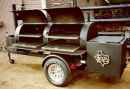
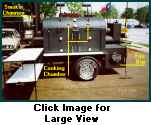
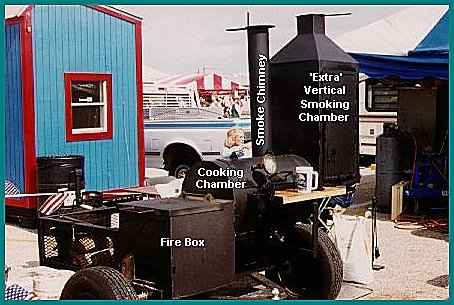
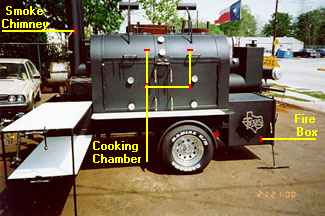
There are many components to a smoker. The basics center around the cooking chamber, the firebox and the chimney.

The Firebox      The Cooking Chamber      The Smoke Chimney

Other Cooker Styles [Press "Back" key to
see additional photos]

Cooker #1
Cooker #2
Cooker #3
Cooker #4
Cooker #5
Cooker #6
Cooker #7
Cooker #8
Cooker #9
Cooker #10
Cooker #11
Cooker #12
Cooker #13
Cooker #14
Cooker #15
Cooker #16
Cooker #17
Cooker #18
Cooker #19
Cooker #20
Cooker #21
Cooker #22
Cooker #23
Cooker #24
Cooker #25
Cooker #26
Cooker #27
Cooker #28
Cooker #29
Cooker #30
Cooker #31
Cooker #32
Cooker #33
Cooker #34
Cooker #35
Cooker #36
Cooker #37
Cooker #38

More to Come!

All three of these parts work together to produce the correct cooking environment. When properly heat controlled, it is possible to produce award winning entrees that will win cookoffs - or the praise of your friends and neighbors. The main responsibility of the cook is to maintain proper heat, consistent flow through the cooking chamber and adequate exhaust.

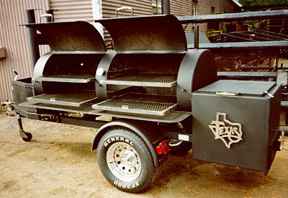
Smokers are rather large, usually weighing in excess of 200 pounds, are not very portable (unless trailer mounted) and require much longer cooking times to turn out a finished product.

If considering the purchase of a smoker, we suggest one large enough to handle a good sized party. It is more than just a little frustrating not to have enough room to cook everything you want. A large smoker also assures you will have sufficient room for your normal cookouts.
Typical Smoker Configuration          

The Firebox

The firebox is usually located to one side of the smoker. This placement is important due to the heat not being situated directly beneath the meat. This type of cooking is termed the indirect cooking method and greatly assists in keeping the meat from being exposed to the direct searing heat from direct heat from directly below the meat. Indirect cooking requires less frequent turning and more cooking time because the meat is being barbecued at roughly 225 degrees instead of grilled at 500 to 700 degrees.

As a note: There are some fireboxes which are located beneath the meat. In these situations, the indirect heating is achieved by increasing the distance between the fire and the meat, placing a solid deflector (i.e. a sheet of metal) horizontally between he fire and the meat and then deflecting the heat to the left and right sides of the pit before reaching the cooking chamber.

Typical fireboxBack to the conventional method. The firebox actually has four separate components. First, there is an adjustable air intake found in the door, secondly a grate inside of it to allow air to flow under the wood/charcoal to keep the fire burning, third, an exit for the heat to enter the cooking chamber and fourth a lid on top with a grilling surface. All but the exit into the cooking chamber can be seen in this photo.

The wood/charcoal is placed on the grate inside the firebox. With the fire burning steady, the opening in the door which controls the air flow into the firebox can be adjusted to regulate the speed at which the fire burns and thus control the temperature inside the chamber. The opening in the firebox door should be located at a low spot in the door which will allow the air to flow under the fire for better ventilation and burn control.
Notice location of vents in the door
If you choose to grill, then the firebox has a lid which can be opened for grilling directly over the heat. This grate should be cleaned thoroughly before grilling since it is subject to prolonged burning directly over the fire. This grilling is usually a little slower than grilling over a small grill, such as a kettle, since the distance from the fire to the meat is usually in excess of 12 inches. You will need a hotter fire as a result.

Between the Firebox and the Cooking Chamber: There is usually a baffle located between the firebox and the cooking area. This baffle, when installed, deflects the heat and smoke downward under the meat. The heat from the firebox rises and hits the lid of the firebox. With the fresh air coming in from one side, the heat and smoke are forced out the other - toward the cooking chamber. If the baffle is not used, then the heat simply goes up over the top of the food and out the chimney thereby bypassing the meat entirely. Sure, some will come in contact with the meat, but a majority will escape and become useless. The baffle is important.

Some pits even have an adjustable damper at this location to assist in the control of the air flow into the cooking chamber.

Older grate needs to be replacedOver time, the fire grate will become weak and unable to support the weight of the wood/charcoal. It is then time to have it replaced for effective use. Don't forget the top of the firebox - Lid Closed Position ... It is an excellent location for a pot of beans, coffee pot or any other item needing to be heated or cooked while at the same time remaining smoke-free. Exercise care however . . . . . . you will find the temperature is extremely hot at this location.

The Cooking Chamber

Smoker Cooking ChamberThe cooking chamber is the closed body of the smoker where the heat is presented to the meat! It is here that you will be doing your cooking. There is a door for easy access and inside a cooking grate for the meat. The meat is placed on the cooking grate which is usually located vertically in the middle of the chamber. Most cooks will place the meat on the grate at the far end from the fire so as to maximize the indirect cooking effect. It also helps when the temperature varies due to adding more coals/charcoal. The temperatures at the far end are more even.
Cooking Chamber & Firebox
The cooking chamber receives heat and smoke from the firebox just after the baffle. It allows the smoke to be circulated over, under and around the meat thus introducing a smoky flavor to the meat being barbecued.

Make sure there is sufficient clearance for the heat/smoke to circulate around the meat. There should be at least 2 inches of clearance between the meat and the inside wall of the cooking chamber. Having such distance allows for even air flow and prevents excess radiant heat from the surface of the cooking chamber.

The Cooking ChamberThe cooking chamber thermometer should be situated in the lid or attached to the chamber at a vertical location equal to the cooking grate. It should not be 6 plus inches above the cooking grate. Heat rises, that's a given. If the thermometer is greater than just a couple of inches, then it will be indicating a chamber temperature HIGHER than that where the meat is actually being cooked. The variation can range in excess of 50 degrees.

A key factor is that the cooking chamber should be large enough to handle all of the barbecuing necessary for a large party. What would be a large party? While everything is relative, 2 turkeys, 3 to 4 briskets and/or 10 to 15 chickens would certainly qualify. You know better the qualifications.

Unless you are using a small smoker, the cooking chamber generally has 2 cooking surfaces. The main surface is located in the middle [from top to bottom], at the widest portion of the cooking chamber. It is here, in this lower portion of the cooking chamber, that most of the cooking is accomplished.

There is usually a second cooking level located above the main surface which is ideal for potatoes or bread, etc. The temperature at this second, or upper, level will be about 50 to 70 degrees HOTTER that at the primary level.

Some smokers will utilizing a water system, the bottom of the cooking chamber [below the main cooking surface] is filled with water. The introduction of water to the cooking chamber provides a "water smoker effect" which is discussed on the "Let's Get Started Page".

The Smoke Chimney
Top Mounted Chimney
What goes in, must go out. It is through the type, placement and use of the chimney which makes the process effective. The chimney does more than simply allow the heat to escape the cooking chamber.

Dual Mid MountMost chimneys are mounted on the top portion of the cooking chamber thus allowing the hottest temperatures to escape. Some of the smarter manufacturers have given this process some thought and have moved the location where the chimney is attached to the cooking chamber down to the mid section or about the level of the cooking grate. Some have even moved it down to near the bottom of the cooker. This traps the heat while allowing the free flow of air which is required for proper cooking.

You can see the various configurations in the photos presented in this section.

The chimney is usually located at the opposite end of the smoker, away from the firebox. This location allows for the smoke to exit after passing over and around the meat being barbecued. Some of the chimneys are located at the top of the cooking chamber and others, as with the water smoking system, are located lower, near the water line, thus keeping the moisture in the cooking chamber.
Dual Short On Smoker Box
Proper use of the chimney: Unfortunately, many cooks will use a damper or lid to restrict the flow of hot air through the chimney. The thinking is that that is the proper method of controlling the heat in the Dual Mid Mountcooking chamber. Nope, that's incorrect. All that does is back up the air flow trapping the smoke in the cooking chamber making the meat bitter and snuffing out the fire. The proper method is to leave the exhaust vent on the chimney open full and then to reduce the heat restrict the air flow into the firebox. This allows for free flow of the heat through the cooking chamber and at the same time adds fresh air for the fire to burn. For those of you who have truly been bit by the bug, you might want to take a few moments to drool over this baby. Check out the World's Largest Smoker!


Check out the Smoker Manufacturers


The Barbecue Store
New Sale Items
all the time! Check out
what's hot in outdoor cooking

For all of your gas grill parts
We have a large selection of replacement parts for almost any type of gas grill

Free Catalogs
Click Here to request free catalogs offered by great suppliers

Barbecue'n Guy!Barbecue'n On The Internet has been serving millions and millions of satisfied readers every year since February 3, 1996

Smoke 'n Fire Enquirer
 

See Our Privacy
Policy Here

Sign up for our newsletter today and begin preparing better barbecue and grilling meals today. It's totally free and contains more great outdoor cooking information.


Sample Newsletter

Email address:

First name:

Last name:

Names are really important to identify you
as we give free stuff away in our newsletters!
Subscribe   Unsubscribe  
      

image
image
image