|
Continued from Page 2
Regardless of the species of wood, excessive smoke is offensive. It is
truly amazing that those whose palates do not rebel at
creosote-contaminated, meat are the same ones who claim that they can
discern the flavor of grape leaves; determine the vintage of wine barrel
French oak; distinguish Mackintosh apple from Northern Spy or June berry
from Huckleberry. Fact is that, except for a few wood species, such as
hickory and mesquite, less than 5% of the palates in the world can tell
what kind of wood was used to cook.
When you hear or read pretentious puffery describing the nuances of
various bouquets of different woods, what you are experiencing is smoke
blowing. Only a confirmed and experienced kapnzophile (lover of smoke)
could identify from the taste of the food, more that 3-4 species of the
most common woods used for cooking.
 Besides being distasteful, cresols and phenols are very hazardous
chemicals. Creosote, a product of cresol, until the Environmental
Protection Agency ban, was used as a wood preservative and the active
ingredient in sheep dip. Phenol is the active ingredient in a long time
favorite bathroom disinfectant. Both are suspected carcinogens. Besides being distasteful, cresols and phenols are very hazardous
chemicals. Creosote, a product of cresol, until the Environmental
Protection Agency ban, was used as a wood preservative and the active
ingredient in sheep dip. Phenol is the active ingredient in a long time
favorite bathroom disinfectant. Both are suspected carcinogens.
This is an excerpt from an article by Dave Lineback, a North Carolinian
who is a scholar and defender of what he terms "traditional" barbecue. His
website address is: http://www.sunsetridge.com.
"Did a little research on the combustion of wood recently. Turns out it's
an interesting subject that has undergone quite a bit of study in recent
years.
Wood does not burn directly. Rather, when heat is applied it first
undergoes a process of thermal degradation called pyrolysis in which the
wood breaks down into a mixture of volatiles and solid carbonaceous char.
The cellulose and hemicellulose form mainly volatiles while the lignin
mainly forms the char. Exactly what products are formed by each depends
upon the temperature, heating rate, particle size, and any catalysts
that might be present.
The solid char remains in place. What goes up with the volatiles are a gas
fraction (carbon monoxide and dioxide, some hydrocarbons, and elemental
hydrogen), a condensed fraction (water, aldehydes, acids, ketones, and
alcohols), and -- here we go! -- a tar fraction (sugar residues from the
breakdown of cellulose, furan derivatives, phenolic compounds, and -- pay
attention here -- airborne particles of tar and charred material which form
the smoke.
If oxygen is present and the temperature is sufficiently high, burning of
the volatiles occurs. When temperatures are too low or when there is
insufficient oxygen for complete combustion of the volatiles, smoldering
occurs. This is characterized by smoking, the emission of unoxidized
pyrolysis products. (This is the awful tasting stuff, creosote, that will
give barbecue a bitter taste.) If the temperature is high enough and
sufficient oxygen is present, then flaming combustion occurs with less
smoking and more complete oxidation of the pyrolysis products. Further
pyrolysis of volatiles during flaming combustion may cause char particles
(soot) to form.
The remaining lignin char burns in the presence of oxygen in glowing
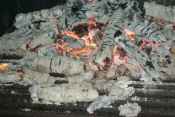
combustion. These are my beloved coals that yield the thin blue smoke that
makes great barbecue! And, that's why it is so important to preburn the
wood to coals."
Dave Lineback
Continued on Page 4

Smoky's 5th basic position for really great barbecue'n.
'According to Smoky' is © by C. Clark Hale
who is solely responsible for its content. Comments
should be addresses to cchale@bellsouth.net
|










 Subscribe now to The Smoke 'N Fire Enquirer, the Internet's most popular backyard grilling and barbecuing on-line tutorial and we'll send you FREE recipes, techniques and tips for preparing the finest outdoor meals. FREE! See a