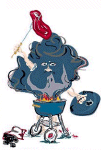
According To Smoky
H E A T !
Summer is great and
Smoky cranks it up!
Welcome to According to Smoky. Here you will find the latest and greatest from C. Clark "Smoky" Hale notable 'baster', author, publisher, television star in both the barbecue and 'the real' world. And yes, he is a real person and not the webmaster.
Smoky will be offering his talents, techniques and secrets discovered over the last 150 years, or so. He will be to the point, pull no punches and if you suffer through the process, you will become a much better outdoor cook, turning out masterpiece meals for friends and family alike.
In this column, Smoky turns up the heat! He will provide a unique insite in to what makes the meat cook on the grill and in the smoker. . . . take notes!
So, with no further adieu, we turn the mike to Smoky. You're on Smoky . . . . .
Thanks PC,
H E A T !
OUTDOOR COOKING WITH SMOKY HALE
Those to whom the Basting Mops were passed by the ancient Keepers of the
Coals, also bear the burden of sharing of the truth in barbecuing. This is
why I am compelled to state unequivocally that there is no "direct heat" there is no “indirect
heat” there is only heat.
Over the years, I have bitten my tongue until it is more scarred than a
politician's conscience when otherwise competent and well meaning people
passed along, as valid, these pernicious phrases of misinformation. (Those
who have errantly ascribed my occasionally slurred speech to an excess of
spirits will now properly feel immense contrition.)
According to the irresistible laws of physics, heat moves from regions or
objects of higher temperature to regions or objects of lower temperature
until a state of equilibrium is reached. Heat moves in only three ways, by
conduction, convection or radiation.
Conduction is the transfer of heat by intimate contact - who among us
could oppose that - and moves from molecule to molecule. For example, the
grate or grill upon which the meat rests, having a higher specific heat
than the meat, conducts heat to the meat. That is why, when the grill is
right, that the beautiful brown stripes magically appear upon the surface
of a steak. Then the exterior of the meat conducts heat to the interior,
molecule by molecule. Conducting is extremely important in barbecuing
because we must conduct the heat from the exterior to the center so slowly
and gently that we do not dry out the exterior. Using low temperature over
the long period is the essential distinction of barbecue from roasting or
broiling. Incidentally, it also allows for more flavoring and more fun
time. Hooray for conduction!
Convection is the transfer of heat by movement of heated masses, i.e. air,
water, oil. In an oven, an enclosed grill or in the path of heated air,
convection is at work. Convection allows us to remove the meat from
directly over the coals and, therefore, tend the coals without disturbing
the meat. It does not restrict the amount of meat which can be
simultaneously cooked to the surface area of the coal bed and fat dripping
from the meat does not drop into the coals.
Radiation is the transmission of heat in waves of energy resulting from
vibration of excited molecules. As when your tongue trembles at the taste
of succulent, savory barbecue, it radiates ecstasy to your brain and other
pleasure receptors. In a closed grill, meat receives radiated heat from the
coals, if it is over them, and from the heated mass of metal in which it is
enclosed.
This may be more than you really want to know about it, but "the intensity
of the radiated heat is directly proportional to the temperature of the
source and inversely proportional to the square of the distance." In
practical terms, this means that meat on a grill over coals and below a
metal cover may receive equal heat radiated from both. Those who have
cooked on a grill with tiered racks have no doubt observed that those
pieces of meat on the top rack (nearest the metal) may brown more quickly
than those on the lowest tier directly over the coals. Likewise, if you
put bread on the top shelf of an oven, the top browns faster than the
bottom, and conversely.
Continued on Page 2

Smoky's 5th basic position for really great barbecue'n.
'According to Smoky' is © by C. Clark Hale
who is solely responsible for its content. Comments
should be addresses to cchale@bellsouth.net |











 Subscribe now to The Smoke 'N Fire Enquirer, the Internet's most popular backyard grilling and barbecuing on-line tutorial and we'll send you FREE recipes, techniques and tips for preparing the finest outdoor meals. FREE! See a