According to Smoky
Welcome to According to Smoky. Here you will find the latest and greatest from C. Clark "Smoky" Hale notable 'baster', author, publisher, television star in both the barbecue and 'the real' world. And yes, he is a real person and not the webmaster
Smoky will be offering his talents, techniques and secrets discovered over the last 150 years, or so. He will be to the point, pull no punches and if you suffer through the process, you will become a much better outdoor cook, turning out masterpiece meals for friends and family alike.
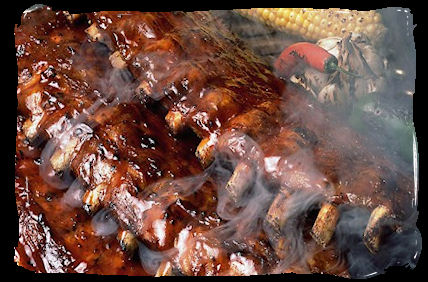
In this column, Smoky works on the basic pork ribs that are mouthwatering good stuff. Hope this helps you folks! . . . . . take notes!
So, with no further adieu, we turn the mike to Smoky. You're on Smoky . . . . .
Thanks PC,
OUTDOOR COOKING WITH SMOKY HALE
By: Smoky Hale
Barbecued Pork Ribs

Cities, like humans, develop characteristics that uniquely define their charms and faults. There are many facets to a city's soul and Ph.Ds may have formulae for divining its depths. But, a better way to judge a city is by looking at what its people like to eat.
Take for instance, ribs. Immediately three cities come to mind Tuscaloosa, AL,
Memphis, TN, Kansas City, MO. All are located on river banks and, except for Memphians love of pulled pork sandwiches, praise ribs above all other barbecue. St. Louis, Chicago and Detroit all have pretensions toward prominence as rib cities, but pale in comparison, although, St. Louis does have the distinction of having a particularly trimmed rack of ribs called the "St. Louis Style".
There is a pattern that emerges in the passion for ribs. Ribs are usually the first
commercially available barbecue in areas outside that nursery of barbecue — the Southeastern United States. An Ol' Baster comes into town and opens up a barbecue pit. Bye and bye, folks will smell the smoke in come in to check things out. The tender, tasty ribs are in many cases the first exposure to barbecue and the experience is like a religious awakening.
Each of these cities have almost as many barbecue restaurants per capita as hamburger joints. Almost. And some of them produce edible barbecue. These are the ones that produce profuse paeans of prose from peripatetic Eastern journalists. Their mushy myths mean that they as gullibly swallow the barbecuer's tales as eagerly as they consume the ribs. The cook who cannot concoct a story as spicy as his sauce is doomed to failure as a barbecuer.
As eager innocents try to duplicate the flavors and textures of barbecue in their own back yards, they are sometimes mislead by the earnest errors of the beguiled journalists. They may also be confused by the various names given to ribs from different areas of the hog. Loin back ribs from the loin section — nearer the backbone than the spareribs are very tender and those from small carcasses and weighing less than two pounds, are called baby back ribs by fanciful merchandisers. Country style ribs are cut from the top ("high on the hog") and contain part of the pork loin section. They are, therefore, very meaty but the meat is loin rather than rib.
The classic barbecued ribs are the spareribs — the lower section of rib cage remaining after the pork chop has been removed. If the chine bone and the brisket bones are removed from the bottom of the rib rack, then the rib section is called St. Louis style.
Pork Bone Structure Chart and Rib Guide
[image]
Spareribs - Before Trimming
[image]
Spareribs - After Trimming
[image]
The choicest spareribs weigh in at less than three pounds — called "three and under" by those who get serious about such things. Larger ribs will be tougher and may require more magic to render them tender. Personally, I avoid the small imported "Danish" ribs because of lack of taste and texture
As discussed in the "Meat" section, pork ribs can be broiled, roasted or barbecued. Those who want a quick fix and don't mind that the texture of the ribs is crunchy rather than tenderly, succulent will be happy with broiling. Some of the more errant may even try to capture the tenderness of barbecued ribs by using meat tenderizers. Those completely lost in the wilderness may even commit the taste robbing travesty of parboiling ribs in a vain attempt to make them tender. If you want to broil, the so-called baby backs, being much more tender, perform better broiled than do spareribs. Country style ribs broil exactly like a pork chop — which they are part of.
Those who cook ribs in the roasting range, between 250 and 350 degrees, get to eat earlier, but at what a price of taste and texture. These are mostly likely the folk who were introduced to ribs by restauranteurs who cooked them fast at roasting temperatures in gas ovens and burnt some ends in their haste. Suffering a lifelong aversion to charred and burned food, I have never learned to appreciate burnt ends.
When it comes to barbecued ribs, beginners may try the faddish, more forgiving loin back; those wanting more meat may cook the country style, but those connoisseurs whose palates can appreciate the taste and texture will insist on the incomparable sparerib— the prize that inspired the rib revolution.
You can produce barbecued spareribs as tender and delicious as any in the ribber cities by following the tried and true techniques of the barbecuing — cooking them low and slow in the gentle, beneficent heat of wood coals serendipitously soaking up the seasonings, smoke and sauces. You only need a few details about selection, preparation, seasoning and cooking to turn out "killer" barbecued spareribs.
Selection
Choose sparerib sections weighing 3 pounds or less, called
"3 and under" in the trade, that are bright pink, moist and not
overly laden with fat. Look for the St. Louis cut because the
brisket bone and chine are mostly waste. Expect to pay a little
more for that reason. If the St. Louis Style is not available, you
can cut or have the butcher cut the chine and brisket bones. Cook
them for sampling. Keep the ribs chilled to around 40 degrees
until you are ready to prepare them. Buy the maximum that your
grill can handle because you can always freeze any leftovers - an
illusion, in most cases - and ten racks of ribs cook as quickly as
one. Reconstituted barbecue is probably better than hot off the
grill.
Preparation
Most skilled barbecuers agree on the necessity of removing
the thick inner lining of the rib section. Some even advocate
removing the thin membrane covering each rib. I find that
unnecessary and a little much. Removing the inner membrane is
really very simple. First step is to insert, somewhere toward the
center of the rack, a rather blunt ended instrument - a Phillips
screw driver, an oyster knife, even a wooden dowel - beneath the
membrane and raise it slightly. Next step is, using a paper towel
or cloth for friction, grasp the raised membrane and pull. It
should come off in one piece. If you have catfish skinning pliers,
they work wonders.
Trim off any extraneous fat and slivers of meat, then
prepare to season. Here is where things get spicy. A serious
controversy rages among the various purveyors of pork as well as
among some adamant amateurs about the proper seasoning of ribs.
Some swear by the dry rub others by the wet basting sauce.
Personally, I do both, have no problems with either and many times
do both on the same rack of ribs. Barbecue is always spiced by
controversy as well as herbs and spices, but those who learn to
use an appropriate basting sauce will never again doubt its value.
I suggest that you do a dry rub and a basting sauce, thereby
illustrating the simplicity of both and allow you to experience
the effectiveness of basting. From the "Basting Sauce" Chapter,
select a basting sauce that seems interesting. Do the same with a
rub from the "Rub" Chapter. As an option, you can use part of the
dry ingredients of the basting sauce recipe as a rub.
I suggest that you start with a rub of the type that your
palate is likely to be familiar with. That is, if you are from the
Kansas City, MO area, start with the Generic KC Style. Texans and
those from Western Louisiana might want to start with the Generic
Texas Style and those from South Louisiana will, naturally, be
more likely to have tasted a Generic Cajun Style. Initially, it is
more important to develop the technique. Once you have perfected
the technique, the seasoning will provide a great range of
variations for your experimentation and delight.
If you use a rub and a basting sauce on the same rack of
ribs, make certain that they use the same set of seasonings and do
not contradict each other.
Apply the rub - rather heavily from 5 minutes to 10 minutes
before putting the ribs on the grill. Sprinkle it on and rub it
in. If basting, apply one coat of the basting sauce and let it
dry, then apply another generous coat just before putting the meat
on the grill.
Preparing the Grill
Barbecuing spareribs will require 5-8 hours of consistent
heat from wood or charcoal coals at around 200-215 degrees.
Therefore, a generous bed of coals should be built in the grill.
Depending upon the capacity of the grill/fire box, the coals will
need to be replenished periodically - a period which only you and
your grill know. Maybe at this point, only the grill knows. But
that is something you must learn for each grill. So begin by
keeping a regular diary which records not only dates, times and
temperatures, but also the ambient temperature, humidity and wind
conditions. Record your results, as well. This will be very
important to you in learning to perfect your ribs.
Refer to Burning Wood and Blowing Smoke Chapter for wood
selection, fire starting and maintaining a replenishment pit.
Gas grill users can approximate the barbecue flavor by
putting green wood or dampened sawdust or wood chips in a
commercially produced container or wrapping in aluminum foil and
punching a few holes in it. Place the container close to the
flames and allow the smoke to build up before putting the ribs in.
Do not do this more than once or risk over smoking. Smoke flavor
is really absorbed in the early stages of cooking. Afterward,
additional smoke residue is deposited on the exterior to the
detriment of the flavor. Electric grillers follow suit.
Barbecuing, The Act
Place the ribs on the grill without their touching. Although some folk hang them vertically, turn them on their sides or creatively roll them up for small grills, I like to lay them flat. I want the juices, seasonings and rendered fat to stay in intimate contact with the meat as long as possible - more flavor is absorbed and surface stays moist longer. A moist surface means that meat can still absorb flavors and heat is transmitted faster and more efficiently through moist tissue.
Close the lid, and adjust the air intake - to reduce the air flow, and check back in about 15 minutes to assure that the temperature at meat level is around 200 degrees. Baste while you are there. Once you have stabilized the grill temperature, go away and play for at least 30 minutes. Check the grill again, and baste and turn if you are using a baste. Check at about 30 minute intervals until you can establish the proper interval for your grill. Even if you are not basting, you may need to turn the ribs and rearrange them because of temperature variances within the grill. Try to get equal heat to all ribs by moving them, if necessary. Do not let any part of them dry out or burn.
Barbecuing ribs, like any other barbecuing, allows lots of time for doing other things than standing around a grill worrying the meat. The total time will be about 5-8 hours, depending upon temperature and weather. Find something fun to do and go do it - checking back occasionally as needed. This is the time to practice becoming a real barbecuer by learning how to enjoy the time spent outdoors with friends and family.
Bye and bye, the rib meat will begin to withdraw from the ends of the bones. This is your signal that they are about ready to eat. It is also the time, if you choose, to reduce the heat and begin basting with the finishing sauce.
Do not expect the rib meat to fall off the bones. Mushiness is not why our teeth crave the sensation meat: texture is. Mashed potatoes are tender, inexpensive and don't require a lot of time or effort to cook. If you want tender, eat mashed potatoes. Meat ought to offer some resistance to the teeth - we pay extra for that. When the ribs are ready, the meat pulls from the bone with minimal effort, but it should still offer some resistance.
By this time, I will have been basting with my finishing sauce of the moment, thinned by a little of the basting sauce. It won't be a garish, brash, ostentatious sauce calling attention to itself, but a mellow sauce, blending like a relaxed barbecuer at a social gathering, melding, mixing, complementing the meat by adding another level of flavors and textures.
The consummate host will slice the ribs individually and serve them warm to table accompanied by a couple of versions of warm finishing sauces.
Smoky tip: After your appetite is sated, carefully taste a rib and record the taste and texture as well as any other pertinent information. If possible, wrap a couple of representative ribs in two layers of aluminum foil, label with date and put into the freezer for comparison later with future batches of ribs. There will come a time when it is so easy and natural, that you'll wonder why you ever did it.
Smoky Has A New Book
The Great American Barbecue & Grilling Manual 416 pages of great information and wonderful recipes. @ The Barbecue Store
|
Smoky
C. Clark Hale
8168 Hwy 98 E.
McComb, MS 39648

Smoky's 5th basic position for really great barbecue'n.
Return to Smoky's Columns
'According to Smoky' is © by C. Clark Hale
who is solely responsible for its content. Comments
should be addresses to cchale@bellsouth.net.
|