|
Continued from Page 2
When it comes to barbecued ribs, beginners may try the faddish, more forgiving loin back; those wanting more meat may cook the country style, but those connoisseurs whose palates can appreciate the taste and texture will insist on the incomparable sparerib— the prize that inspired the rib revolution.
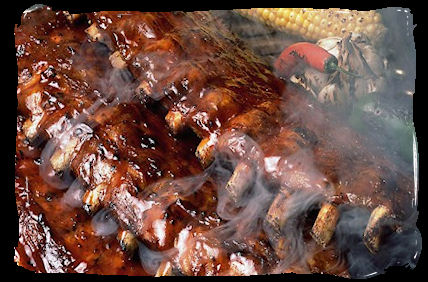
You can produce barbecued spareribs as tender and delicious as any in the ribber cities by following the tried and true techniques of the barbecuing — cooking them low and slow in the gentle, beneficent heat of wood coals serendipitously soaking up the seasonings, smoke and sauces. You only need a few details about selection, preparation, seasoning and cooking to turn out "killer" barbecued spareribs.
Selection
Choose sparerib sections weighing 3 pounds or less, called
"3 and under" in the trade, that are bright pink, moist and not
overly laden with fat. Look for the St. Louis cut because the
brisket bone and chine are mostly waste. Expect to pay a little
more for that reason. If the St. Louis Style is not available, you
can cut or have the butcher cut the chine and brisket bones. Cook
them for sampling. Keep the ribs chilled to around 40 degrees
until you are ready to prepare them. Buy the maximum that your
grill can handle because you can always freeze any leftovers - an
illusion, in most cases - and ten racks of ribs cook as quickly as
one. Reconstituted barbecue is probably better than hot off the
grill.
Preparation
Most skilled barbecuers agree on the necessity of removing
the thick inner lining of the rib section. Some even advocate
removing the thin membrane covering each rib. I find that
unnecessary and a little much. Removing the inner membrane is
really very simple. First step is to insert, somewhere toward the
center of the rack, a rather blunt ended instrument - a Phillips
screw driver, an oyster knife, even a wooden dowel - beneath the
membrane and raise it slightly. Next step is, using a paper towel
or cloth for friction, grasp the raised membrane and pull. It
should come off in one piece. If you have catfish skinning pliers,
they work wonders.
Trim off any extraneous fat and slivers of meat, then
prepare to season. Here is where things get spicy. A serious
controversy rages among the various purveyors of pork as well as
among some adamant amateurs about the proper seasoning of ribs.
Some swear by the dry rub others by the wet basting sauce.
Personally, I do both, have no problems with either and many times
do both on the same rack of ribs. Barbecue is always spiced by
controversy as well as herbs and spices, but those who learn to
use an appropriate basting sauce will never again doubt its value.
I suggest that you do a dry rub and a basting sauce, thereby
illustrating the simplicity of both and allow you to experience
the effectiveness of basting. From the "Basting Sauce" Chapter,
select a basting sauce that seems interesting. Do the same with a
rub from the "Rub" Chapter. As an option, you can use part of the
dry ingredients of the basting sauce recipe as a rub.
I suggest that you start with a rub of the type that your
palate is likely to be familiar with. That is, if you are from the
Kansas City, MO area, start with the Generic KC Style. Texans and
those from Western Louisiana might want to start with the Generic
Texas Style and those from South Louisiana will, naturally, be
more likely to have tasted a Generic Cajun Style. Initially, it is
more important to develop the technique. Once you have perfected
the technique, the seasoning will provide a great range of
variations for your experimentation and delight.
Continued on Page 4

Smoky's 5th basic position for really great barbecue'n.
'According to Smoky' is © by C. Clark Hale
who is solely responsible for its content. Comments
should be addresses to cchale@bellsouth.net.
|










 Subscribe now to The Smoke 'N Fire Enquirer, the Internet's most popular backyard grilling and barbecuing on-line tutorial and we'll send you FREE recipes, techniques and tips for preparing the finest outdoor meals. FREE! See a